
What Inks Are Compatible with LED UV Offset Curing?
To effectively run an LED UV offset press, you must use LED-specific UV inks formulated to cure within the narrow UVA wavelength range of 385nm to 395nm. Unlike standard UV inks that require broad-spectrum light from mercury lamps, LED UV inks rely on highly reactive photoinitiators that trigger polymerization instantly under low-heat LED output.
Attempting to use conventional UV or oil-based inks with an LED curing system will result in uncured, tacky sheets and potential equipment damage. For optimal performance, you need "high-reactivity" (HR) or "LED-curable" offset inks, which are readily available from major manufacturers like Hubergroup, T&K Toka, Toyo, and INX.
The Science Behind LED UV Ink Compatibility
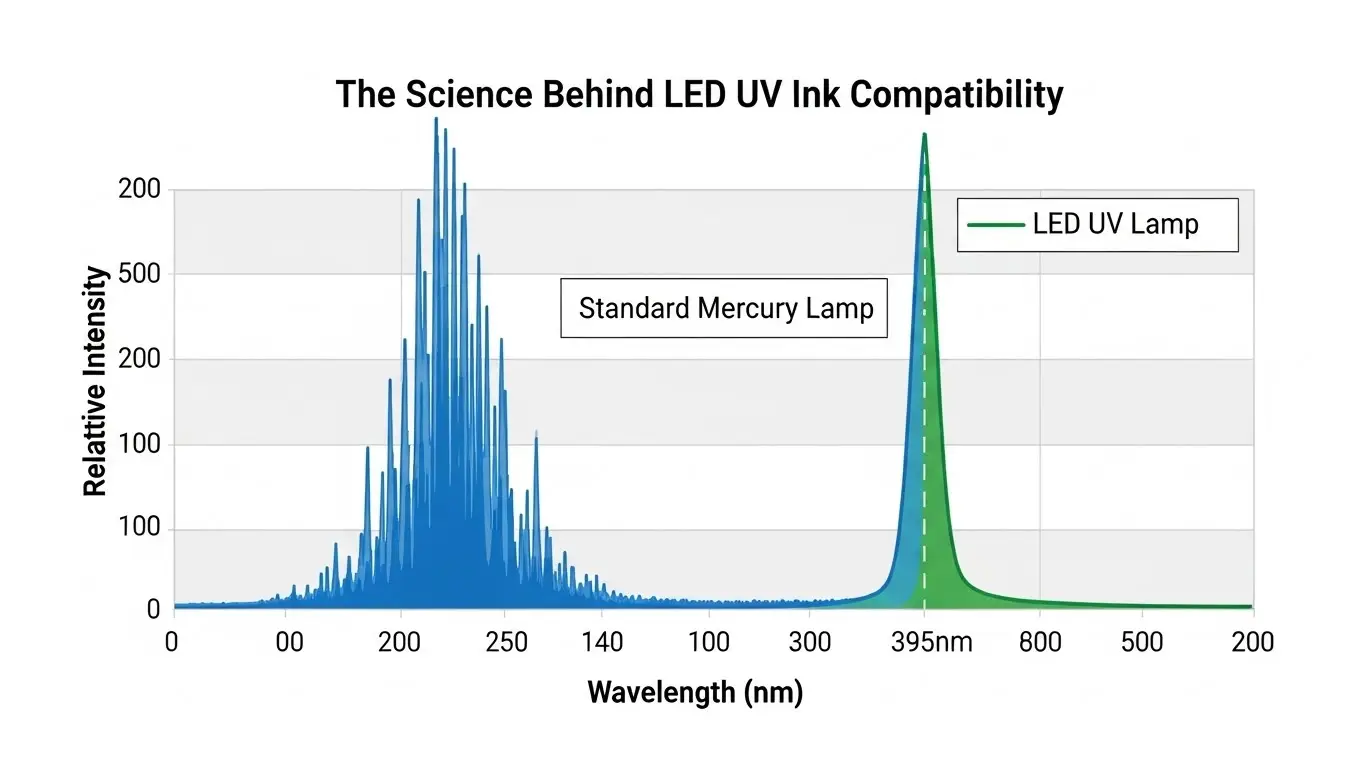
Understanding why specific inks are required starts with the curing mechanism. Standard UV lamps bombard the sheet with a wide spectrum of light (from 200nm to 700nm). In contrast, LED UV lamps emit a precise, monochromatic peak of energy.
Photoinitiators: The Key Ingredient
The primary differentiator in LED UV inks is the photoinitiator package.
- Standard UV Inks: Contain photoinitiators that absorb energy across a broad range, including short-wave UVC (which LEDs do not produce).
- LED UV Inks: Are formulated with photoinitiators specifically sensitive to the 385nm or 395nm bands. These are often more expensive but offer significantly higher reactivity, allowing the ink to cure instantly even with the lower energy density of LED arrays.
Viscosity and Rheology
LED UV inks often have a slightly different viscosity profile to accommodate the lack of heat on the press.
- Heat Management: Standard UV lamps generate massive heat, which thins the ink on the rollers.
- Stable Viscosity: Since UV LED curing systems run cool, LED inks are designed to maintain stable tack and flow properties at lower operating temperatures (typically 20°C - 25°C), preventing issues like piling or misting.
Can You Use Standard UV Inks with LED Systems?
No, you cannot use standard UV inks with an LED curing system.
This is the most common misconception in the industry. If you run standard UV inks under LED lamps:
- Incomplete Cure: The ink surface may feel dry (due to some overlap in the UVA spectrum), but the "through-cure" (adhesion to the substrate) will fail.
- Rub-Off Issues: The ink will likely rub off during finishing or shipping.
- Wasted Energy: You would need to run the press at dangerously slow speeds to achieve even a partial cure, negating the efficiency benefits of LED.
However, the reverse is often true: LED UV inks can typically be cured by standard mercury lamps, as mercury lamps do emit the 385-395nm wavelengths required by LED inks. This makes LED inks a versatile "dual-use" option for print shops running hybrid press configurations.
Critical Factors for Choosing LED UV Inks
When selecting an ink series, consider these three technical factors to ensure compatibility with your specific press setup.
1. Wavelength Matching
Ensure your ink supplier matches the ink's sensitivity to your lamp's peak output.
- 395nm: The industry standard for offset printing. Most HR (High Reactivity) and LED inks are optimized for this.
- 385nm: Sometimes used in specialized coating or inkjet applications but less common in offset due to cost.
2. Substrate Compatibility
One of the biggest advantages of LED UV is the ability to print on heat-sensitive substrates. Ensure your ink series is compatible with:
- Plastics (PVC, PET, PP): Requires inks with higher adhesion promoters.
- Uncoated Papers: Requires inks with high hold-out to prevent absorption before curing.
- Metallized Papers: Requires excellent surface wetting properties.
3. Dual-Cure Capabilities
If you have a press with both inter-deck LED lamps and end-of-press mercury lamps (a hybrid setup), ask for Dual-Cure inks. These allow you to switch between curing modes without washing up the press, maximizing uptime.
Essential Checklist for Ink Transition
If you are retrofitting a press, don't just swap the ink. You must prepare the entire ink train.
- Rollers: You must use EPDM rollers designed for UV printing. Standard rubber rollers will swell and crack when exposed to UV monomers.
- Washes: Use only UV-compatible washes. Oil-based washes will contaminate the ink and prevent curing.
- Blankets: Install dedicated UV blankets to ensure proper ink transfer and release.
See our full guide on what to check before retrofitting LED UV on an offset press for a complete breakdown.
Frequently Asked Questions
What is the difference between H-UV, LE-UV, and LED-UV inks? H-UV (Komori) and LE-UV (Low Energy) are proprietary or general terms for low-energy curing systems that may use doped mercury lamps or LEDs. While the concepts are similar, the specific photoinitiators differ. Always specify "LED-curable" to your ink vendor to ensure the photoinitiators match the 395nm LED output.
Are LED UV inks more expensive? Yes, LED UV inks are typically 10-20% more expensive than standard UV inks due to the cost of the specialized photoinitiators. However, this cost is usually offset by energy savings (up to 70%), instant drying times, and the elimination of anti-setoff powder. Learn more in our article: How to Choose LED UV Curing for Offset Printing.
Do LED UV inks require a special fountain solution? Yes, you generally need a UV-compatible fountain solution. Because LED inks run cooler and have different water pick-up characteristics than oil-based inks, your dampening solution needs to be adjusted to maintain the correct ink-water balance.
Does LED UV curing eliminate setoff? Absolutely. Because the ink cures instantly upon exposure to the light, the sheets are dry before they hit the delivery pile. This completely eliminates setoff and the need for spray powder. Read more here: Does LED UV Curing Reduce Setoff in Offset Printing?.
Key Takeaways
- Specific Formulation: You must use inks labeled "LED-UV" or "High Reactivity (HR)," specifically tuned to 385-395nm wavelengths.
- No Cross-Compatibility: Standard UV inks will not cure properly under LED lamps, though LED inks often work under standard lamps.
- Total System Approach: Switching to LED inks requires compatible EPDM rollers, washes, and blankets.
- Cost vs. Value: While per-kilo ink costs are higher, the operational savings from energy efficiency and faster turnaround times typically yield a higher ROI.
Conclusion
Choosing the right ink is the single most critical factor in the success of your LED UV printing operation. By ensuring you select a high-quality series formulated for the 395nm spectrum, you unlock the full potential of your press—crisper dots, higher gloss, and instant finishing.
Ready to optimize your curing process? Contact us today to discuss which LED UV curing system matches your specific ink and production requirements.
Share on Social:


