
UV Curing of Printing: The Future of Modern-Day Printing
- In recent years, the printing industry has experienced a stunning change, and UV curing for printing has been one of the most innovative developments in the printing industry. With the high-speed commercial printing to advanced packaging solutions, UV printing technology is a technology that is efficient, of high quality, and sustainable in nature. Modern printers achieve high-quality prints that are durable, with high-resolution and low production time, with the addition of UV ink curing processes, plus consuming less energy.
- When you are looking into methods of bettering your printing process, lessening the longevity of your print, or lessening the dry-out period of printing inks, it is vital to learn about UV curing systems in printing. This paper goes into the UV printing process, UV light curing as a printing method and how new technologies such as LED UV curing lamps as a printing method are innovating the future of the industry.
What is UV Curing in Printing?
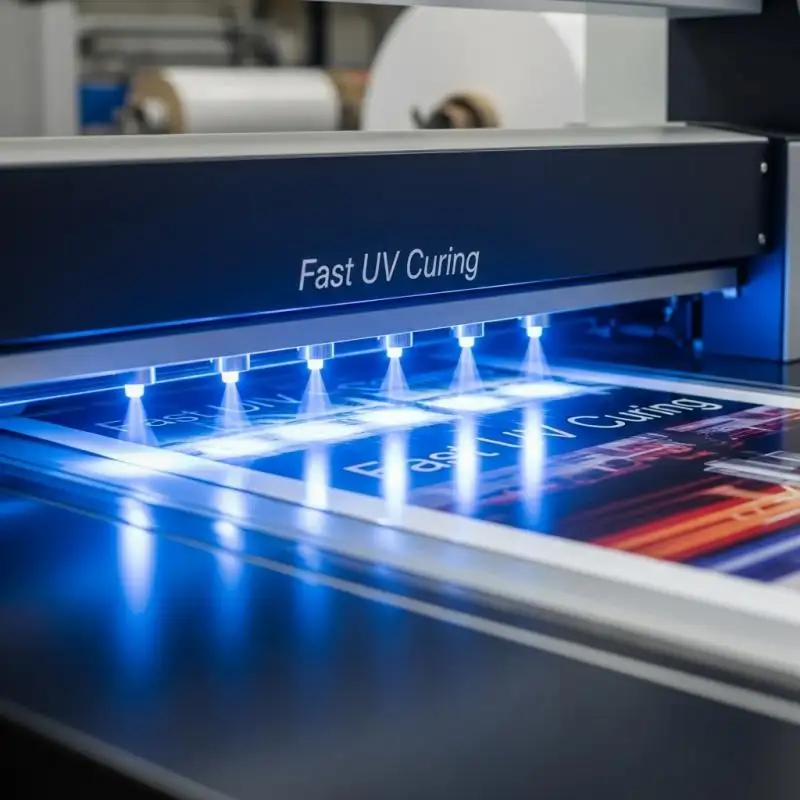
The basis of UV curing for printing is the rapid curing of inks and coatings by UV light. Compared to the conventional drying process, which is done by the use of solvents or heat, UV drying uses ultraviolet light to solidify ink on different surfaces immediately. It is a printing photopolymerization process in which inks that react to UV light are treated to produce a permanent and high-quality print surface when they are exposed to special wavelengths of light.
The main elements of the UV printing process are:
- UV-cure inks: Special inks, which require hardening in UV light.
- UV curing lamps: These are devices that produce the specified UV wavelengths required for the quick polymerization of ink.
- Printing devices: UV curing screen printers, flatbed inkjet printers, and digital printers.
This not only guarantees quick drying inks but also enables the finishing of high-resolution print making it suitable for commercial, digital, and industrial printing.
Types of UV Curing Systems
There are many types of UV curing equipment used in modern printing systems, and each is intended to be used in a particular application. The primary types include:
- LED UV Curing Technology
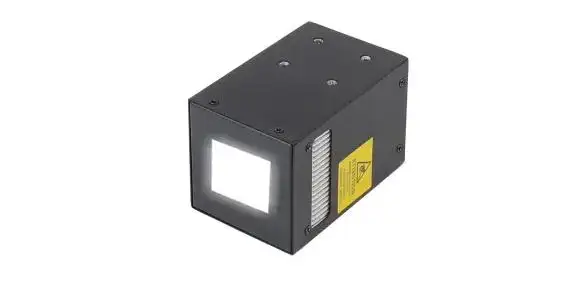
The printing industry has experienced a revolution through UV LED curing technology, which is a high-speed, energy-saving technology. Compared to the old mercury lamps, LED UV lamps still have specific wavelengths like 365nm, 385nm, 395nm, or 405nm, which make sure that the lamp is still precise in its curing and results. UV LED curing printing saves on energy and generates less heat, and also does not require warm-up periods.
- Mercury UV Curing Systems
The conventional mercury lamps offer general UV light to cure. Although efficient, such systems use more energy, and they need more cooling systems.
- Conveyor UV Curing Systems
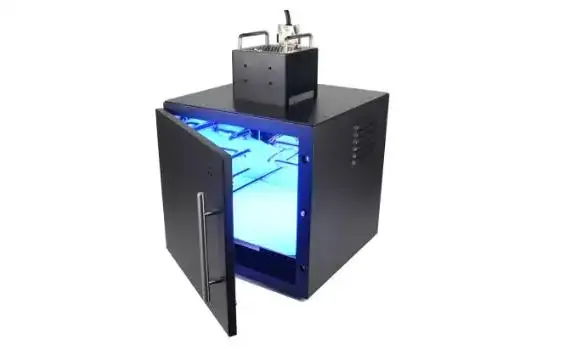
These systems are ideal for volume production, where UV curing ovens are integrated with the printing system so that the printed material can pass through the UV light to get continuity and speedy curing.
- Flatbed UV Curing Units
These units are specifically configured to work with flatbed inkjet systems, which means that they can fit large substrates and that the curing process is even throughout extensive printing areas.
UV Curing of Printing
The steps required in the process of UV printing are several steps that make it different from the traditional printing process:
- Ink Application- UV-curable inks are placed on the substrate.
- UV Light Exposure - The ink is directly subjected to ultraviolet light, and polymerization is caused.
- Ink Hardening - The ink hardens immediately, forming a stable, smudge-free surface.
- Finishing -3. UV coating may also be applied to provide extra protection, gloss, or even matte.
Using UV curing in flexible packaging, printers will be able to adhere to plastics, metals, and paper, among others, with excellent adhesion. This variety is essential in the case of label printing in UV and industrial graphic printing, where longevity and accuracy play the most important role.
Advantages of UV Curing in Printing
The advantages of UV curing in printing are many, and it is understandable why it is the preferred method of printing in the modern printing business:
- Quick Drying: Ink dries virtually instantly, saving on production time.
- Durable Prints: UV ink polymerization is used to make prints that are scratch-resistant and water-resistant.
- Energy Efficiency: LED UV systems are less energy-consuming compared to traditional curing systems.
- Eco-Friendly: No solvent evaporation implies that VOC emissions are reduced and therefore the UV printing technology is more environmentally friendly.
- High-Resolution Printing: Produces bright images with vivid colors.
- Versatility: Accepts different substrates that are both rigid and flexible.
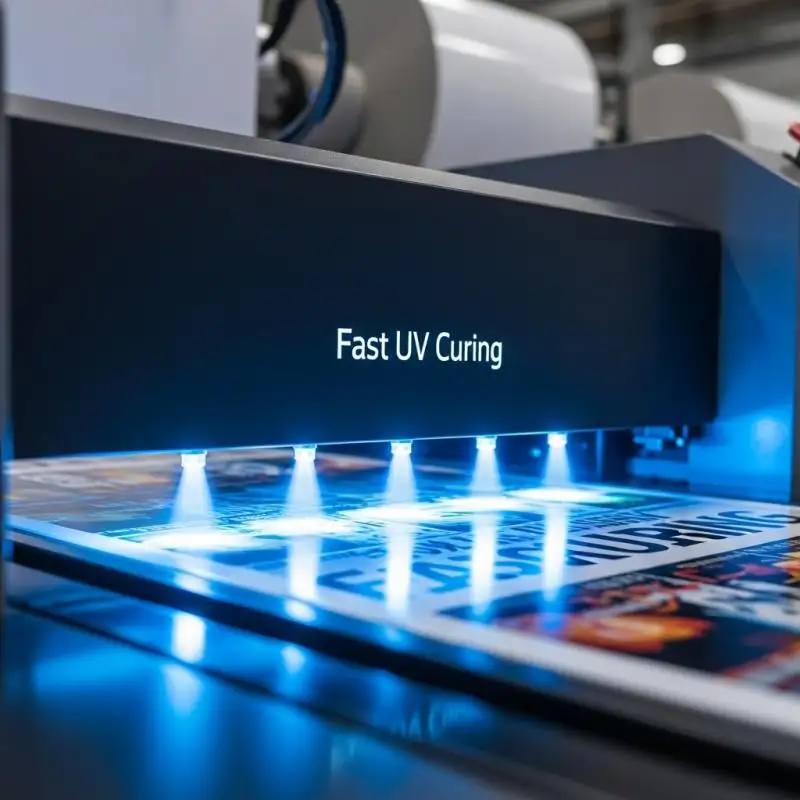
Under UV curing, compared to traditional drying in printing, businesses have had better workflows, less waste, and better printed materials.
Technical Solutions UV LED Curing Lamps in Printing
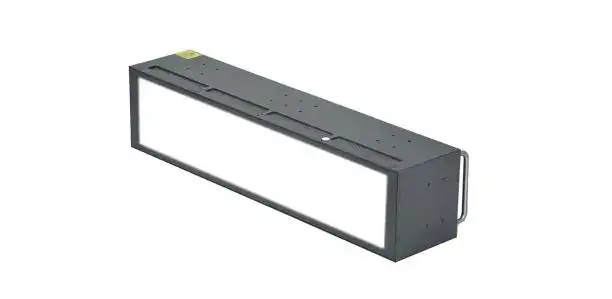
One of the best solutions that will enable UV printing is BLED UV Curing Lamps for Printing that is based on UVET. Such lamps are high-performance, precision, and energy-efficient.
Model: UVSN-250P
- UV intensity: Up to 12 W/cm2
- Wavelength: 365nm, 385nm, 395nm, 405nm.
- Irradiation area: 200x20mm
- Cooling: Heat is dissipated by fans.
- Uses Flatbed inkjet printing, digital printing, and 3D printing.
The lamps give rapid UV curing of printing operations to give quality prints. The flexible intensity and exposure time enable the operators to tune the curing to different inks and substrates. These lamps are also productive as they cost less to operate since they generate less heat when compared to other lamps, and they have an efficient operation.
Industrial Applications
The UV curing solutions are very commonly used in various industries because of their effectiveness and application in a variety of applications:
- Commercial Printing: Flyer, brochure, and signage printing at high speed.
- Digital printing: Fast-curing digital prints of large and small scale.
- Packaging Printing: UV packaging printing enhances packaging printing adhesion, durability, and quality of finishing.
- Flexible Packaging UV Cure: Ideal in plastic labels, pouches, and films.
- Industrial Graphic Printing: Outdoor displays, signage, and large-format prints.
- 3D Printing: Special UV inks, finer models, and prototypes.
Through the introduction of industrial UV curing of printing, companies can attain consistency in their outcomes, besides minimizing downtime and wastage of materials.
The selection of an appropriate UV Curing System
The choice of the appropriate UV curing system to use on printers must consider several factors:
- Wavelength compatibility: The lamp and the inks must be compatible.
- UV intensity: Increased UV intensity will allow curing at a higher rate.
- Substrate compatibility: Do not use rigid, flexible, or heat-sensitive substrates.
- Energy efficiency: LED systems cut down on power usage.
- Small size: Small lamps, such as the 200x20mm line of UVET, can be easily combined with other lamps.
Conclusion
UV curing for printing has changed the industry approach on production, quality, and sustainability. Printing can also be performed with great precision, efficiency, and durability through the use of innovative technologies such as LED UV-curing technology, UV-curing inks, and high-quality UV-LED curing lamps. From commercial printing to flexible packaging, UV curing printing solutions provide outstanding performance and require less energy and less environmental impact. Visit UVET.
Share on Social:


