
Flexo LED UV Curing: Benefits and Setup Considerations

In the fast-paced world of label and package printing, flexo LED UV curing has emerged as the definitive standard for efficiency, quality, and sustainability. If you are still relying on conventional mercury arc lamps, you are likely battling excessive heat, high energy bills, and frequent downtime. Switching to LED technology isn’t just an upgrade; it is a fundamental shift that empowers converters to print faster on a wider range of substrates with superior consistency.
This guide explores why top-tier flexo operations are transitioning to LED UV curing and details exactly what you need to know to implement it successfully.
What Is Flexo LED UV Curing and How Does It Work?
Flexo LED UV curing is a photopolymerization process that uses high-intensity Light Emitting Diodes (LEDs) to instantly dry inks, coatings, and adhesives on a flexible web.
Unlike broad-spectrum mercury lamps that emit heat and ozone, LED systems output narrow-band UV energy (typically 385nm or 395nm). This targeted energy penetrates deep into the ink layers, triggering an immediate reaction with photoinitiators. The result is a fully cured, durable print ready for immediate finishing, without the thermal stress that distorts sensitive materials.
The Core Mechanism
- Electrical Efficiency: LEDs convert electricity directly into UV light with minimal waste.
- Cold Curing: The absence of infrared (IR) radiation keeps the web cool.
- Instant On/Off: No warm-up or cool-down cycles are required, maximizing press uptime.
Why Should You Switch to LED UV for Flexo Printing?
Switching to LED UV offers three critical competitive advantages: a 50-80% reduction in energy costs, the ability to print on heat-sensitive thin films, and significantly higher press speeds.
Unmatched Energy Efficiency
Traditional mercury lamps are notoriously inefficient, turning a vast amount of electricity into wasted heat. LED systems consume significantly less power and only draw energy when the press is running.
- Direct Savings: Drastically lower electricity bills.
- Infrastructure: Reduced load on facility HVAC systems.
Expanded Substrate Capability
Heat is the enemy of shrink sleeves and thin flexible packaging. Mercury lamps often cause these materials to curl or distort, leading to registration errors. LED UV curing is a "cool" process, transferring minimal heat to the substrate. This allows you to run:
- Shrink films (PVC, PETG, OPS)
- Thermal papers
- Thin unsupported films (BOPP)
Increased Uptime and Lamp Life
Mercury bulbs degrade quickly (typically lasting 1,000–2,000 hours) and require frequent replacement. In contrast, UV LED units can last over 20,000 hours.
- Consistency: LED output remains stable over years, not weeks.
- Maintenance: No shutters, reflectors, or bulbs to constantly clean and replace.
Deep Dive: For a broader look at how this technology transforms label production, read our guide onUV LED Curing for Flexo & Labels.
How Does LED UV Improve Cure on High-Speed Web Printing?
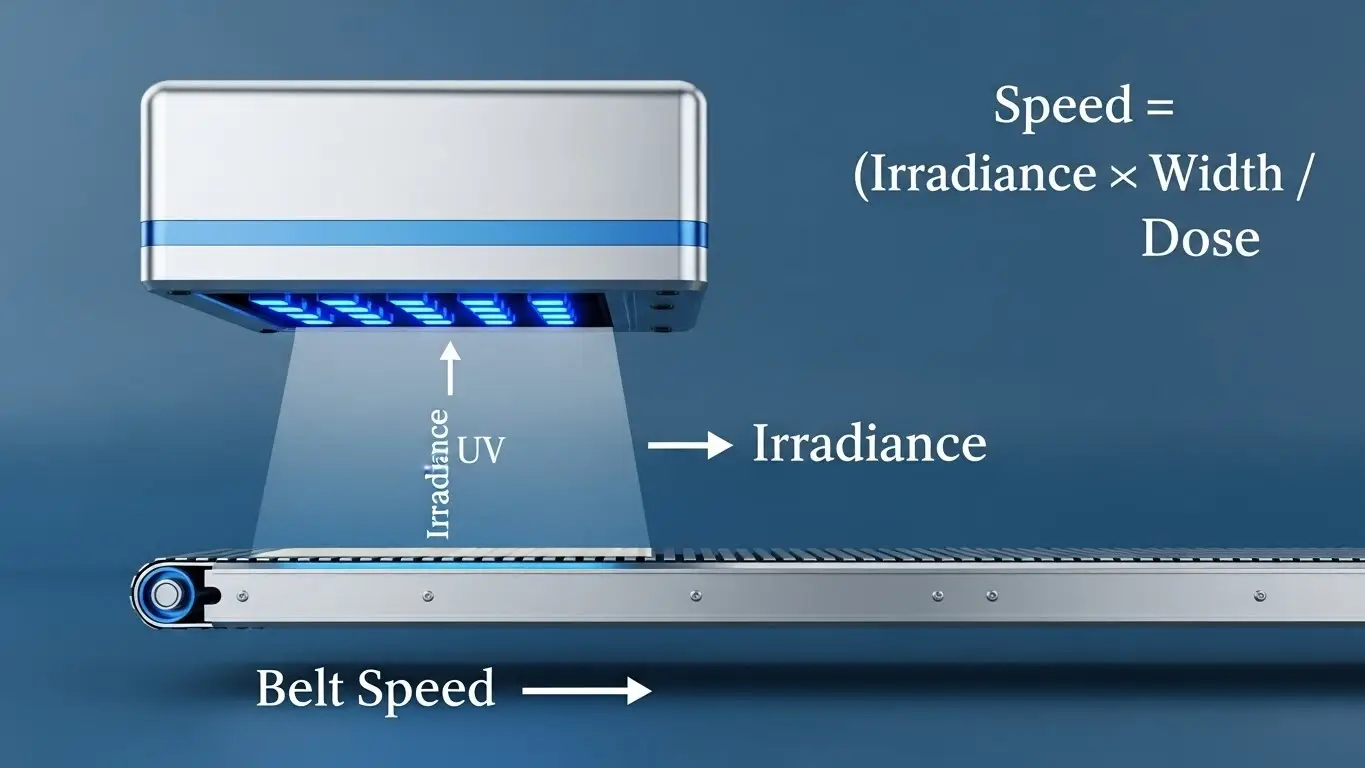
LED UV improves high-speed curing by delivering high peak irradiance that penetrates thick ink layers instantly, ensuring through-cure even at speeds exceeding 1000 fpm.
Overcoming the Speed Limit
In high-speed web printing, the "dose" (total energy) limits how fast you can run. If the web moves too fast under a mercury lamp, the ink may not cure completely at the bottom, leading to adhesion failure.
LED systems solve this with High Peak Irradiance. The concentrated energy drives the chemical reaction faster and deeper.
- Through-Cure: Ensures the ink bonds firmly to the substrate.
- Surface Cure: Prevents tackiness (oxygen inhibition) when matched with the right ink formulations.
Stability at Speed
On a high-speed press, vibration and heat fluctuation can affect mercury lamps. LED arrays are solid-state and unaffected by press vibration, delivering uniform UV energy across the entire web width regardless of speed.
Expert Tip: Achieving these results requires precise integration. Learn more about optimizing your line in our article:How to Improve Cure on High-Speed Web Printing.
What Wavelength Is Best for Flexo UV Inks?
The industry standard for flexo UV inks is 395nm because it offers the best balance of deep penetration (through-cure) and compatibility with modern LED-formulated inks, though 385nm is utilized for specific surface-cure applications.
The 395nm vs. 385nm Debate
Choosing the right wavelength is critical for ink adhesion.
- 395nm (The Standard): This wavelength penetrates deeper into ink layers, making it ideal for thick screen whites, heavy blacks, and laminating adhesives. Most major ink manufacturers formulate their primary LED flexo series for 395nm.
- 385nm: Sometimes used for clear coatings or specific applications where surface curing is challenging. However, 385nm LEDs typically have slightly lower radiant power output than 395nm chips.
- 365nm: Rarely used in flexo due to lower efficiency and higher cost, though common in spot-curing adhesives.
Spectral Matching
You cannot simply "guess" the wavelength. You must ensure your LED array matches the absorption peak of the photoinitiators in your ink. Mismatches lead to weak curing and "gummy" ink films.
Technical Detail: Confused about the spectrum? We break down the physics and choices in our guide:What Wavelength Is Best for Flexo UV Inks?.
How Can You Reduce Odor in UV Flexo Inks with LED Curing?
LED UV reduces odor by eliminating ozone generation entirely and preventing the "cooking" of substrates, while its high curing efficiency minimizes unreacted monomers that cause chemical smells.
The Two Sources of Print Odor
- Ozone: Traditional UV lamps generate ozone, a pungent gas that requires heavy extraction. LED UV produces zero ozone, instantly improving the pressroom environment.
- Uncured Monomers: If ink isn't fully cured, residual chemicals (monomers) remain active and can migrate or off-gas. This is a major concern for food packaging.
Achieving Low-Migration Compliance
LED's consistent output ensures that the proper UV dose is delivered every time, reducing the risk of under-curing. Furthermore, because LED units run cool, they don't heat the substrate. Hot substrates often release their own plasticizers or odors—a common issue with mercury lamps known as "substrate off-gassing."
Safety Focus: For converters targeting food or pharma packaging, controlling odor is non-negotiable. Read our strategy guide:How to Reduce Odor in UV Flexo Inks with LED Curing.
What Is the Best UV LED Curing System for Flexo Label Printing?
The best system features a compact, modular design with water-cooling for high-intensity stability, seamless integration with press controls, and a high-efficiency optical window that maximizes energy transfer to the web.
Key Selection Criteria
When evaluating systems, look for these four features:
| Feature | Why It Matters |
| Water Cooling | Essential for high-power systems to maintain 100% intensity during long runs. |
| Modular Design | Allows you to easily move units between print stations (e.g., for "wet-on-dry" or "wet-on-wet" configurations). |
| Instant Integration | The system should "talk" to your press (PLC integration) for automatic speed-sensing power adjustment. |
| Replaceable Windows | Glass windows on the lamp head should be easily field-replaceable if splashed with ink. |
A robust system isn't just a light source; it's a productivity tool that should require near-zero maintenance.
Buying Advice: Don't settle for underpowered units. Compare features and specs in our review of theBest UV LED Curing System for Flexo Label Printing.
Setup Considerations: How to Retrofit Your Flexo Press
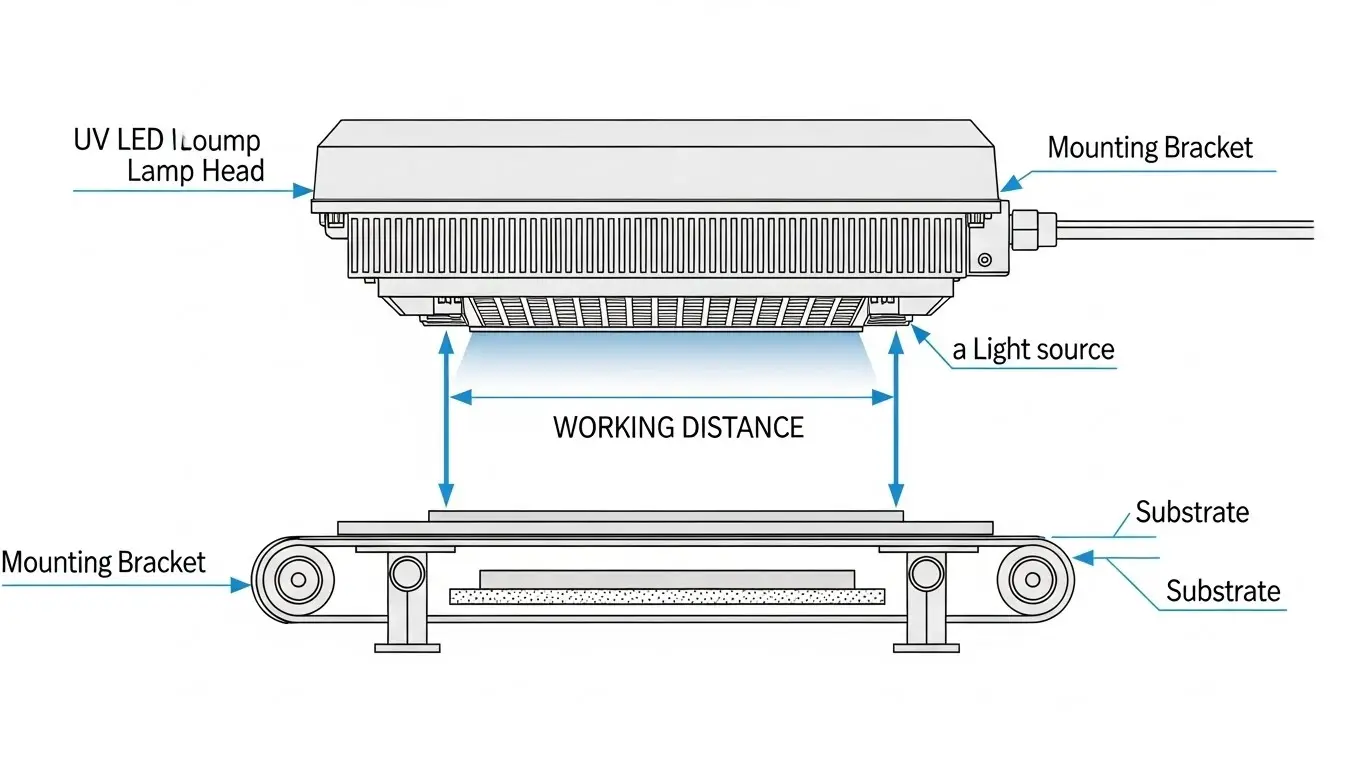
Successful retrofitting requires verifying ink compatibility, establishing proper cooling plumbing (for water-cooled units), and positioning the lamp head at the precise focal distance (typically 2-10mm) from the web.
The Ink Transition
Before you bolt on new hardware, audit your ink room.
- Action: Confirm your current ink supplier has an "LED-formulated" or "Dual Cure" version of your Pantone and CMYK sets.
- Tip: Do not try to cure standard mercury inks with LED lamps; they often lack the correct photoinitiators for the 395nm narrow band.
Cooling and Plumbing
While air-cooled units exist, high-speed flexo presses usually require water-cooled LED systems for maximum power density.
- Chiller Location: Plan space for the chiller unit (usually small and portable).
- Hose Routing: Ensure coolant hoses are routed safely through the press frame to avoid kinks or friction against moving parts.
Mounting and Focal Point
Distance is everything. LED energy dissipates quickly over distance.
- Gap: The emission window should be 2mm to 10mm from the substrate.
- Shielding: LED light is incredibly intense. Ensure proper light shields are installed to prevent stray UV light from curing ink on the anilox rolls or plates.
Oxygen Inhibition (The Surface Cure Challenge)
Oxygen in the air can inhibit the curing of the very top layer of ink, leaving it tacky.
- Solution: Use high-power LED units (16W/cm² or higher) to punch through this inhibition layer.
- Inertion: For extreme applications (like food packaging), nitrogen inertion chambers can be added to displace oxygen, though modern high-power LEDs rarely require this for standard labels.
Electrical Integration
The LED driver needs to know when the press stops.
- Interlock: Wire the system so the LEDs turn off instantly when the press halts. This prevents burning the stationary web—a major advantage over mercury lamps that need shutters.
Conclusion
The shift to flexo LED UV curing is no longer a futuristic concept; it is the current standard for competitive printing. By eliminating warm-up times, cutting energy costs by half, and unlocking the ability to print on heat-sensitive materials, you effectively upgrade your entire press's capability.
Whether you are retrofitting a legacy press or specifying a new line, the key to success lies in choosing the right wavelength (395nm), ensuring ink compatibility, and selecting a robust, water-cooled system designed for the rigors of industrial production.
Ready to modernize your flexo process? Explore our range of high-performance LED solutions at UVNDT.com.
Share on Social:


