
Can UV LED Replace Mercury UV Completely?
Determining if UV LED can replace mercury UV in your facility requires a deep look at your material chemistry and production speeds. While many industries are making the switch, the transition is not always a simple one-to-one swap. You must evaluate how the narrow-band light of an LED system performs against the broad-spectrum output of traditional lamps. This guide explores the technical realities, the applications where replacement is already standard, and the factors you should weigh before making a final decision for your manufacturing process.

What Does It Mean for UV LED to Replace Mercury UV Curing?
Replacing mercury UV with UV LED refers to meeting equivalent process needs under defined conditions like cure depth, surface hardness, and bond strength. You must ensure that the new light source can trigger the same chemical reactions in your coatings that the old system did. This means that "replacement" is a matter of matching performance metrics rather than just changing a lamp head. If your finished part meets all quality checks without slowing down your line, the replacement is successful.
In What Applications Is UV LED Already Replacing Mercury UV?
UV LED has replaced mercury UV in many modern industrial applications where heat sensitivity and energy efficiency are top priorities. You will find that industries using thin-film plastics, digital inkjet printing, and delicate electronic bonding have almost entirely moved to LED technology. These sectors benefit from the lack of infrared heat, which prevents your materials from warping or melting during the curing stage.
- Digital Printing: LEDs allow for instant drying on labels and flexible packaging without the risk of substrate distortion.
- Electronics Assembly: You can use LEDs to cure adhesives on sensitive sensors and microchips that would fail under high-heat mercury lamps.
- Medical Device Production: The consistency and cool operation of LEDs ensure that plastic medical tools maintain their shape and structural integrity.
- Wood Coating: Many flat-line wood finishing processes use LEDs to set topcoats quickly while reducing the fire risk associated with hot mercury bulbs.
In What Situations Does UV LED Still Face Challenges Compared to Mercury UV?
There are specific use cases where UV LED faces limitations relative to mercury UV, particularly when dealing with thick, opaque, or legacy coatings. You might find that the narrow wavelength of an LED does not penetrate deeply enough into certain dark inks or high-build resins. Traditional mercury lamps provide a "cocktail" of wavelengths that can often reach through complex materials that an LED cannot yet handle without significant chemical reformulation.
- Surface Tack: Without the short-wave UVC light found in mercury lamps, some of your coatings might remain slightly sticky on the surface.
- Opaque Materials: Thick, white, or highly pigmented coatings often require the broad-band energy of mercury to cure all the way to the substrate.
- Legacy Formulations: If you are using older inks that are not "LED-curable," they simply will not harden under an LED light source.
- Line Speed vs. Depth: On very high-speed lines with thick coatings, you might find that the dosage from an LED system is not yet enough to ensure a full structural bond.
How Do Differences in Heat and Temperature Between LED and Mercury UV Affect Replacement?
Differences in heat and temperature behavior influence replacement decisions by changing how your substrates and machinery react during the process. You will notice that mercury lamps emit a large amount of infrared energy, which heats up your parts, your conveyor, and the surrounding air. UV LEDs stay much cooler, which allows you to process thin films that would otherwise melt, but it also means you lose the "secondary" heat that sometimes helps certain chemical reactions in traditional setups.
Removing this heat from your line can improve your part quality and reduce your air conditioning costs. However, you must also consider how your chemistry is tuned. Some older resins actually rely on that infrared heat to flow better before they set. If you remove the heat by switching to LED, you might need to adjust your process or your material recipe to get the same smooth finish you had before.
How Should ROI Be Evaluated When Considering Replacement?
ROI evaluation requires looking at both short- and long-term operational factors such as energy consumption, bulb life, and maintenance labor. You should calculate how much you currently spend on replacing mercury bulbs every 1,000 hours and the electricity wasted during lamp warm-up. While the initial cost of an LED system is higher, you often see a return through a 70% reduction in power use and a lifespan that extends to 20,000 hours or more.
- Uptime Gains: Factor in the time saved by eliminating the 15-minute warm-up and cool-down periods required by mercury lamps.
- Maintenance Savings: Calculate the labor saved by not having to clean reflectors or handle hazardous mercury bulb disposal.
- Scrap Reduction: Include the value of the parts you no longer lose to heat-related warping or melting.
- Environmental Impact: Consider the savings from removing expensive ozone exhaust systems and the regulatory benefits of a mercury-free shop.
What Practical Steps Should Guide a Replacement Decision?
Replacement decisions should be guided by testing, metrics, and process validation rather than assumptions. You should start by auditing your current materials and reaching out to your suppliers to see if LED-compatible versions are available for your specific job. Never commit to a full system until you have run samples through a pilot LED setup to verify that the cure meets your hardness and adhesion standards.
- Audit Material Compatibility: Confirm with your ink or adhesive supplier that your materials will react to 365nm or 395nm light.
- Conduct Small-Scale Testing: Run your parts under an LED lamp to check for surface tack and deep-bond strength.
- Analyze Your Workflow: Determine if the "instant-on" feature of LED will allow you to speed up or change your conveyor layout.
- Calculate Total Cost of Ownership: Look at energy, maintenance, and scrap rates over a three-to-five-year period.
- Validate Safety Compliance: Ensure your new setup includes the proper UV shielding for your operators.
What Are the Key Takeaways on Whether UV LED Can Replace Mercury UV?
Your decision to replace mercury with LED depends entirely on whether your material chemistry can be matched to the LED’s narrow wavelength. While LED is the superior choice for heat-sensitive parts and energy savings, mercury still holds a place for broad-spectrum, thick-film applications.
- LED is already the standard for many sectors of printing and electronics.
- Mercury is still often needed for thick, opaque, or non-reformulated coatings.
- Replacement is a chemical and mechanical process, not just a hardware swap.
- ROI is usually realized in the long term through lower power and maintenance costs.
- Testing and validation are the only ways to ensure a successful transition.
How Do UV LED and Mercury UV Curing Technologies Differ?
To understand the core physics, you can read our technical breakdown of UV LED vs mercury UV curing. This explains how light generation and spectral output change the way your materials react on a molecular level.
What Limitations of UV LED Curing Affect Replacement Potential?
Before you switch, you should be aware of the limitations of UV LED curing. This section covers the challenges with surface cure and penetration depth that might affect your specific product line.
How Do Temperature and Heat Generation Compare Between LED and Mercury UV?
Managing the thermal profile of your shop is a major part of your job. You can find detailed data on UV LED curing temperature to see how much cooler your production area could be after a switch.
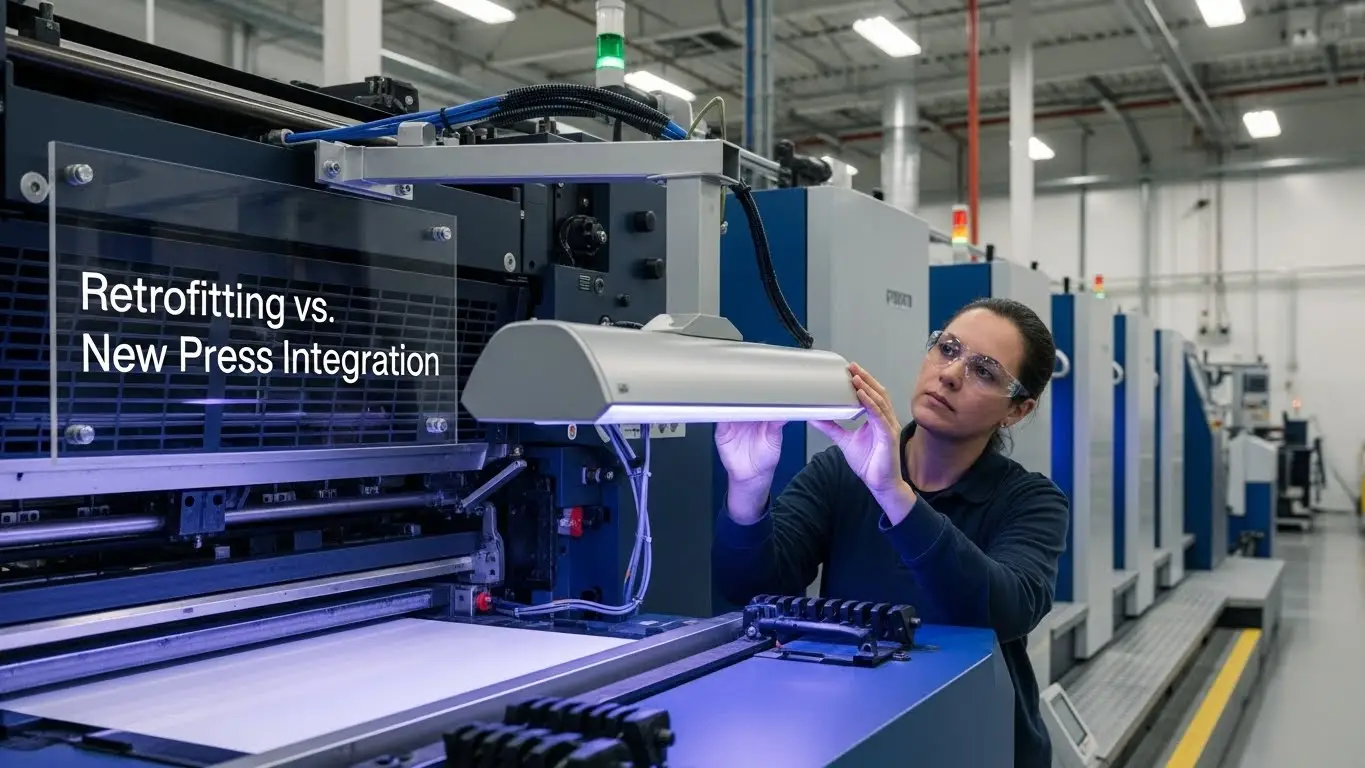
What Should You Know About Retrofitting Mercury UV Systems to UV LED?
If you want to keep your current machinery but change the light source, you need to understand the retrofit process. You can also learn about the general considerations for replacing mercury UV with LED to help plan your downtime.
How Should ROI Be Evaluated When Comparing UV LED to Mercury UV Replacement?
For a deeper look at the financial side, check our guide to UV LED curing ROI. This covers the hidden costs of mercury and the long-term gains of moving to a solid-state system.
What Questions Should You Ask Before Replacing Mercury UV With UV LED?
A structured evaluation is the safest path forward. You can use our guides to deciding between UV or LED lamps and the differences in light characteristics to help build your internal checklist.
Final Thoughts
Finalizing your decision on whether to replace mercury UV with LED requires you to balance immediate equipment costs with long-term process stability. As manufacturing moves toward faster, cleaner, and more precise methods, the shift toward LED technology is likely to continue growing across almost every sector. However, the most successful replacements are those that prioritize material testing and process validation above all else. By ensuring your chemistry and your light source are perfectly matched, you can build a production line that is not only more efficient but also significantly more reliable.
Share on Social:


